CRM isn't broken. Networking is simply less structured.
CRM software solves an important business problem. Salesforce currently defines CRM as a system for managing interactions with customers and prospects, helping teams improve relationships, streamline processes and drive growth.
That structure is exactly what makes CRM powerful. Once a company knows who the prospect is, what the opportunity is, who owns it, what happens next and how the relationship fits into a commercial process, a CRM creates order.
Professional relationships often begin before those answers exist. A founder may become a partner. An investor may matter during your next raise. A recruiter may become useful six months from now. A prospect may simply have the wrong timing today.
The early question is not always “Is this a lead?” It is often “Why might this relationship matter later?”
The missing layer isn't contact storage. It's relationship retrieval.
We already have plenty of places to store people. The problem appears later, when you remember the situation but not the name: “Who was the FinTech founder from that conference who wanted to discuss partnerships?”
At that moment, knowing that the person's phone number exists somewhere is not enough. You need to recover the relationship from the information you actually remember.
| System | What it is excellent at | The question it may not answer on its own |
|---|---|---|
| Phone Contacts | Identity and communication details | Why did I save this person? |
| Professional identity, career information and discovery | What happened when I met them? | |
| Email / Messaging | Individual conversations | Why does this relationship matter across interactions? |
| Calendar | Scheduled interactions | What made the relationship relevant in the first place? |
| CRM | Prospects, opportunities, pipeline and structured customer activity | What about valuable relationships that aren't yet part of that process? |
| Professional memory layer | Origin, context, relevance and next action | Helps make the relationship retrievable before it becomes formal. |
Why “not important yet” can become important later
A large LinkedIn experiment published in Science studied more than 20 million people over five years. During the experiments, 2 billion new ties and 600,000 new jobs were created. The researchers found causal evidence that tie strength affected job mobility, with the effect varying by how tie strength was measured and by industry.
The research is about employment outcomes—not sales, partnerships or CRM—so it should not be stretched beyond what it tested. But it does support an important professional-network principle: relationships outside your closest circle can matter to future opportunity.
Source: Stanford Digital Economy Lab summary of the randomized LinkedIn experiments, published in Science (2022).
A useful network is more than its size.
LinkedIn's Economic Graph has also modelled professional network strength using four dimensions: network size, the characteristics of connections, communication frequency and how non-redundant the information pathways in the network are.
That research is focused on career and economic outcomes, but it highlights an important distinction for anyone managing professional relationships: simply collecting more connections is not the same as building a network that remains useful.
The problem gets larger faster than it feels.
Consider a networking-heavy professional who attends 2 relevant events per month and has 15 meaningful new conversations at each event.
This is an illustrative scenario—not an industry benchmark. The arithmetic is simply 2 × 15 × 12 = 360. Nobody needs perfect recall for 360 people. They need enough information to recognise the right relationship when a future situation makes it relevant.
The hidden cost isn't forgetting everyone. It's missing the right person at the right moment.
Most networking systems fail quietly. Nothing looks broken. The contact is still in your phone. The LinkedIn connection still exists. The email thread may still be searchable.
The failure becomes visible only when a new need appears and you cannot connect that need to somebody you already met. You scroll through contacts, search old chats, ask teammates—or simply meet someone new to solve a problem your existing network may already contain an answer to.
That is why retrieval quality matters more than raw contact count. A smaller network you can navigate can be more useful than a larger one you cannot interpret.
Why context helps: memory depends on cues.
A peer-reviewed meta-analysis of environmental context-dependent memory found reliable context effects across the studies it reviewed. The research does not test professional networking specifically, so we should be careful not to claim that an event tag automatically makes someone memorable.
What it does support is the broader point that context can influence recall. In professional relationships, cues such as the event, topic, company, promise or timing can become practical handles for finding your way back to a person.
You may forget the name first—but still remember the situation.
So what should you actually preserve after meeting someone?
You do not need a meeting report. A useful minimum record can answer five questions.
Rahul Mehta
Tech Summit
Partnership
Send deck
Tuesday
What changes when context is preserved?
Name, number and company. Enough to identify him, but not enough to explain why he matters.
Enough context to recognise the relationship and restart the conversation later.
Once there is a clear objective, owner, timeline and formal next step, the relationship can move into the appropriate business workflow.
When should the relationship move into CRM?
There is no universal rule because businesses structure sales differently. But there is a practical test.
| Signal | Example |
|---|---|
| A defined business objective exists | Sell, partner, recruit, invest or procure |
| The relationship belongs to a formal process | Opportunity, candidate process or partnership pipeline |
| Someone owns progression | Sales rep, recruiter or partnerships manager |
| There is a concrete next step or timeline | Demo Friday, proposal due or interview scheduled |
A useful pre-pipeline workflow has four jobs.
Capture → Preserve → Retrieve → Act.
Capture the person while the interaction is fresh. Preserve enough context to explain why the relationship mattered. Retrieve the person through the details you are likely to remember. Then act when a real next step exists.
A system that performs only the first step is still primarily a contact database. The value comes from continuity across all four.
Where Allbuddy fits
Allbuddy is built around capturing, preserving and retrieving professional relationships—especially in the early stages, when the eventual value of the relationship is not yet fully structured.

Capture
Capture the person while the introduction is still fresh through the way the interaction actually happens.
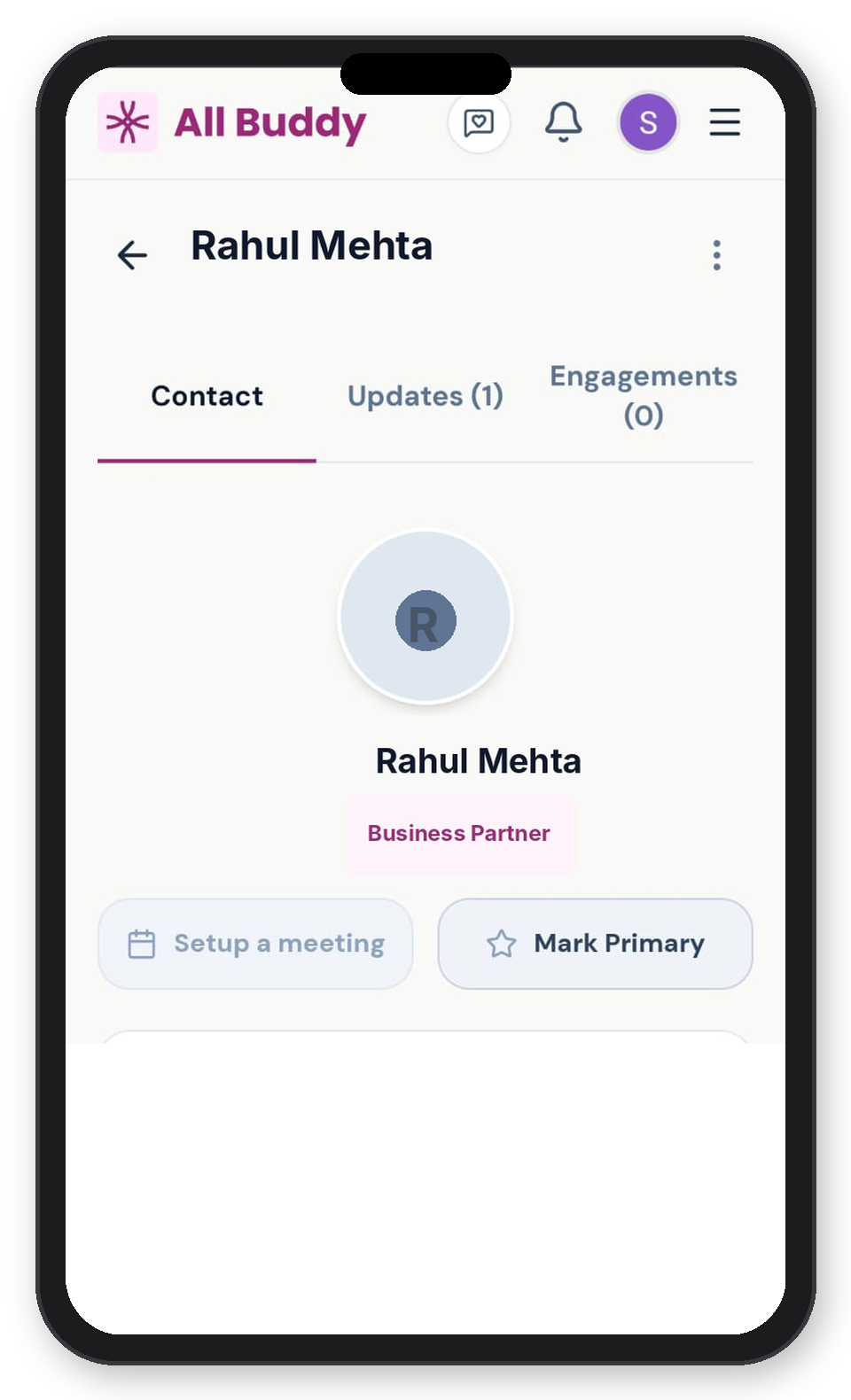
Preserve
Keep enough context to remember why the relationship mattered without turning networking into administration.
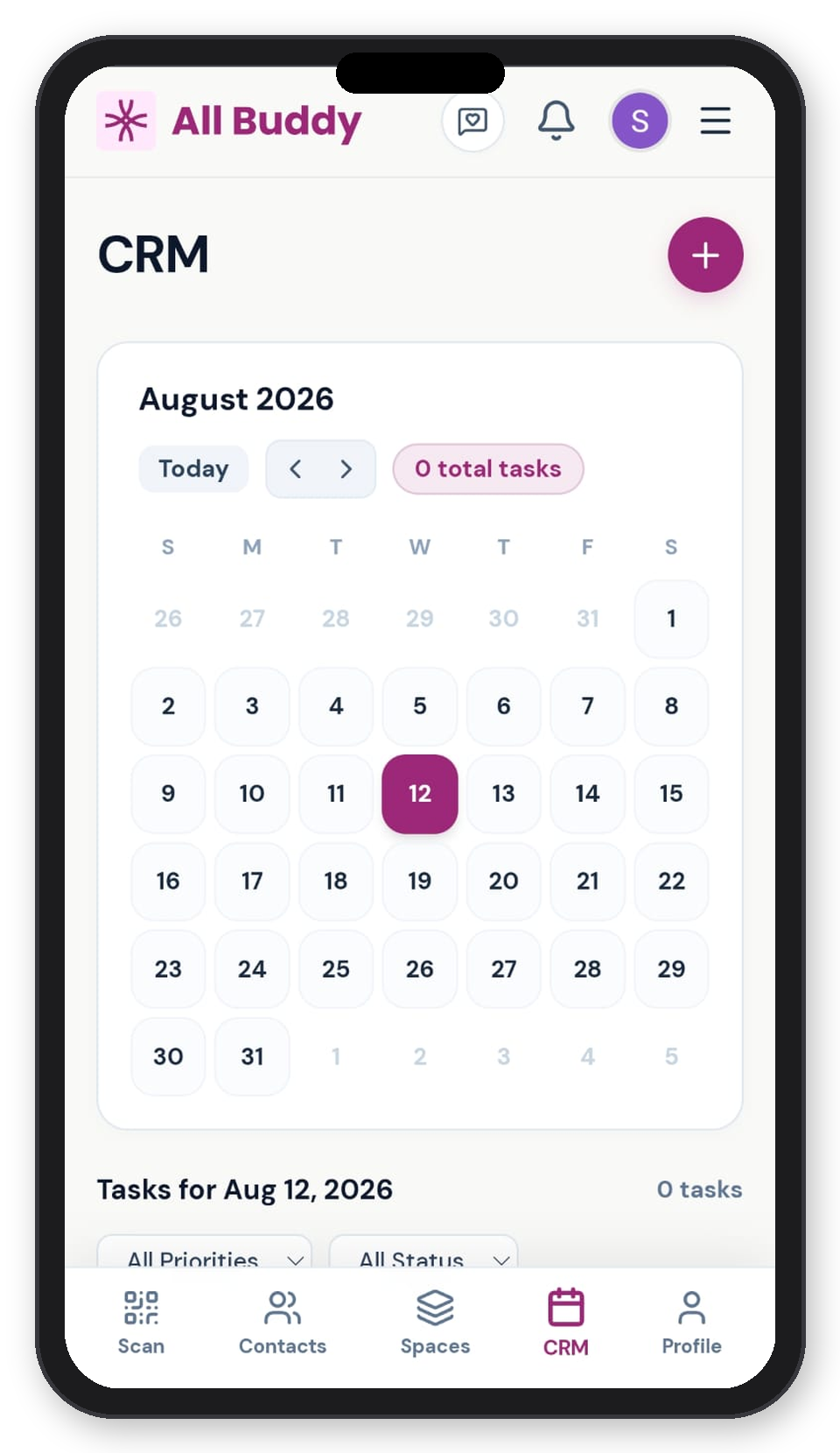
Retrieve and act
Find the relationship later and continue from the same context—follow up, schedule or move forward.
Where Allbuddy ends and CRM begins
If a relationship becomes an active sales opportunity with a deal value, pipeline stage, forecasting requirements and structured account ownership, the CRM remains the appropriate system of record.
Allbuddy's role is different: it is most useful around the earlier professional relationship—when you have met someone worth remembering, but the eventual value of that relationship is not yet fully structured.
The better question isn't “How many contacts do I have?”
A large contact list is easy to build. A useful professional network is harder.
The more useful question is: “When I need a person, can I find the relationship I already have?”
The next opportunity in your network may not look like an opportunity when you first encounter it. That is why the period between meeting someone and knowing what the relationship will become deserves its own workflow.
Frequently Asked Questions
What is the difference between networking and CRM?
Networking creates and develops professional relationships across customers, partners, investors, candidates, peers and other contacts. CRM provides a structured system for managing customer and prospect relationships and formal commercial activity.
Should every person I meet go into my CRM?
Not necessarily. Many professional relationships begin before there is a clear commercial objective, owner, stage or next step.
Isn't LinkedIn enough for professional networking?
LinkedIn is excellent for professional identity and discovery. Your private relationship context—where you met, what you discussed and why the relationship matters to you—is a different layer.
What information should I save after networking?
At minimum: identity, origin, relevance, commitments and timing.
Does Allbuddy replace CRM?
No. Allbuddy is designed around capturing and remembering professional relationships, particularly around the moment they begin. CRM remains better suited to structured pipeline and revenue-management workflows.
Sources and verification notes
- Salesforce — What is CRM? Used only to describe the scope of CRM around customers, prospects and structured interactions.
- Stanford Digital Economy Lab — A Causal Test of the Strength of Weak Ties Source for the 20M+ people, 2B new ties, 600K new jobs and five-year experimental window.
- LinkedIn Economic Graph — Network Strength Source for the four-part network-strength framework.
- Smith & Vela (2001) — Environmental context-dependent memory: review and meta-analysis Used cautiously to support the general role of context in recall; it is not a networking study.
Don't just build a bigger contact list.
Build a network you can actually retrieve when it matters.